Compress PDF: guide, privacy and troubleshooting
Compress PDF is designed for a specific document workflow: compress pdf online free — shrink file size in seconds. The best results start with a source file that opens correctly and has the pages or content you actually want to process. Before you begin, check that you selected the right document, confirm its orientation and page count, and keep an untouched copy if the file is important. This is especially useful for invoices, reports, application forms, study material and other documents where a small conversion difference can matter.
How to use Compress PDF
- Open the heavy PDF file.
- Set the quality and image scale — 0.7 and scale 1.5 are a good balance.
- Download the smaller PDF and compare the result.
After the tool finishes, download the result and open it in the application where you plan to use it. Check page order, headings, tables, symbols, images and any fields that matter to your workflow. PDF is a fixed-layout format, while formats such as Word and Excel represent content differently; conversions can therefore need a small manual correction. Scanned pages also behave differently from digital PDFs because the page may contain an image rather than selectable text. When a result does not look right, try a clearer source scan, a smaller batch, or the related tool linked on this page.
Privacy and local processing
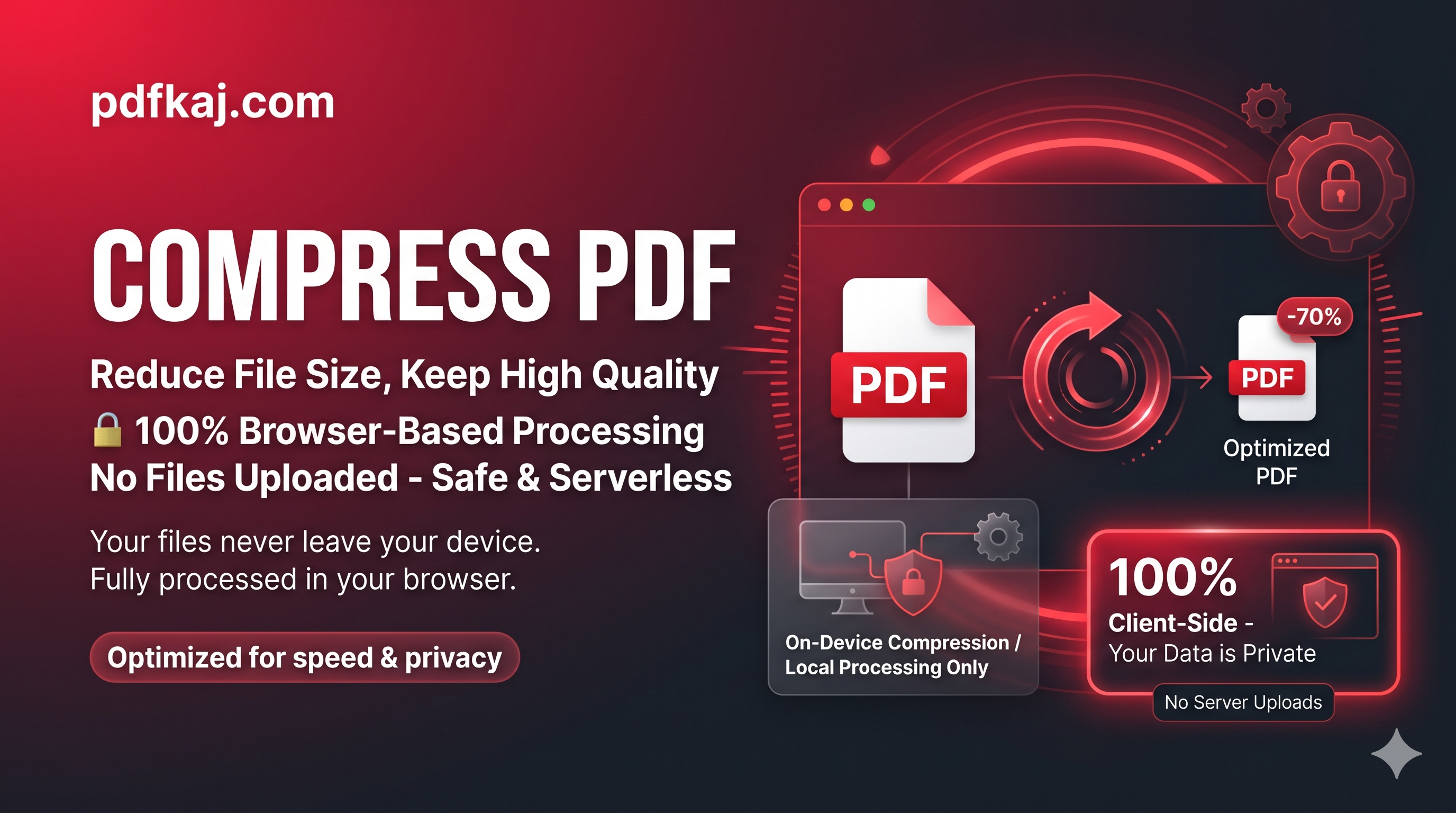
PDFKaj's client-side tools process document content in your browser instead of uploading it to a PDFKaj document-processing server. The browser downloads the application code and any required libraries, then uses your device to read the selected file and prepare the output. Your original file remains unchanged; the generated file is offered for download. Some tools need an internet connection the first time they load code or language data, and the optional AI document assistant is different: it can send extracted text to OpenAI only after you provide a key and explicitly consent. Read the Privacy Policy for the details and exceptions.
Performance and troubleshooting
Processing takes memory as well as time. Large PDFs, high-resolution scans and documents with hundreds of pages may use substantial RAM, especially on phones or older laptops. If the browser becomes slow, close other tabs, try a smaller file, split a long PDF into sections, or use a device with more available memory. Keep the tab open until the download finishes. A failed conversion does not mean the source file was changed; retry with a copy and check whether the PDF is password-protected, damaged or unusually complex.
Large-file performance notice
Frequently asked questions
How much smaller will my PDF be?
Scanned documents often drop by 60–90%. Text-only PDFs are already small, so savings are smaller.
Will the text stay selectable?
No. Pages are rebuilt as images, which is exactly why the file gets so much smaller.
How do I get the best size for email?
Lower the scale first (1.2–1.5) and then the JPEG quality (0.6–0.7) until you hit your attachment limit.